
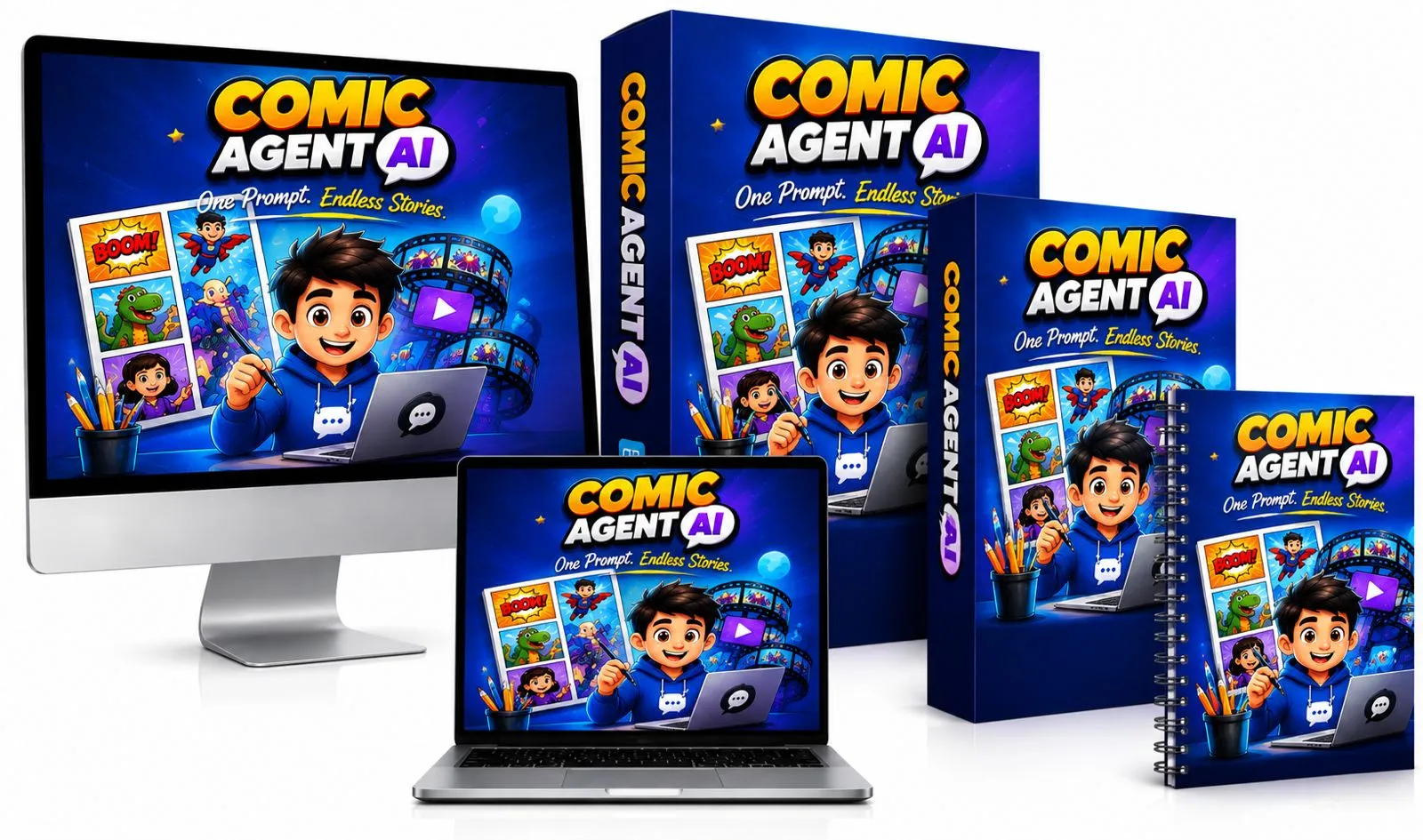
I’ve reviewed enough AI products to know that “fully automated” can mean almost anything.
Sometimes it means you type one sentence and get a finished product.
Sometimes it means you type one sentence, click seventeen buttons, fix three things and wonder where the automation went.
So when I came across ComicAgent AI, I wasn’t particularly interested in another AI tool that promises to make comics.
I wanted to know what the $17 version actually does, what sits behind the upgrades and whether there’s a sensible business use for it beyond the usual “make money with AI” pitch.
ComicAgent AI is marketed by Yogesh Choudhary and Arpit Jain as an AI kids-content system that can create comics, storybooks, coloring books, videos, worksheets and other children’s content from a simple idea. The current sales page advertises a $17 front-end with a 30-day money-back guarantee.
And yes, there are several upgrades.
We’ll get to those.
What is ComicAgent AI?
ComicAgent AI is an AI-powered content creation platform aimed primarily at children’s content.
The basic pitch is simple:
Give it an idea and let the system turn that idea into a finished content product.
The sales page says the platform can handle story creation, character development, illustrations, speech bubbles, page layouts, covers, formatting and exports. It also promotes comic-to-video creation, coloring books, storybooks and marketing assets.
That’s quite a lot for $17.
Which is exactly why I wouldn’t judge the product based on the feature list alone.
The real question is how much of that functionality you get at the entry price and how useful the output actually is.
What can ComicAgent AI create?
According to the current offer, the platform goes well beyond traditional comic books.
The advertised content types include:
- Comic books
- Children’s storybooks
- Coloring books
- Characters
- Covers
- Animated videos
- Worksheets
- Printables
- Rhymes and songs
- AI tutoring content
- Marketing assets
- Landing pages
- Kids websites
The sales page also advertises multi-language translation and a character consistency system designed to keep characters looking consistent across pages, covers and videos.
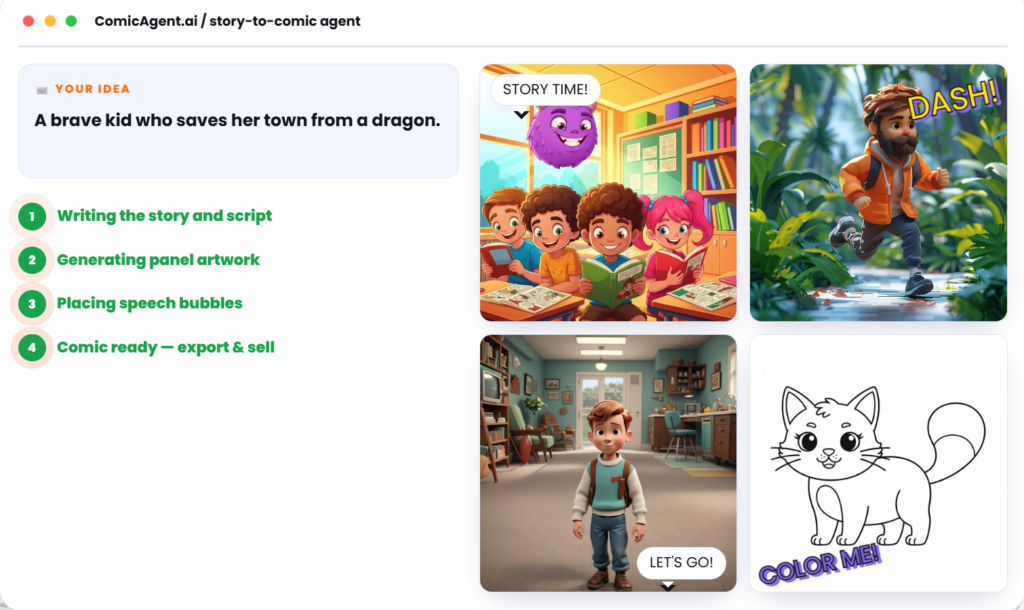
Place the sales-page collage showing the different content formats here. Caption: “Examples of content formats promoted by ComicAgent AI.”
That’s a surprisingly broad package.
The more interesting question is whether all those features are useful to the same person.
Probably not.
Someone making one children’s coloring book doesn’t need an AI business agent, reseller license and whitelabel software.
That would be like buying a bakery because you wanted one muffin.
The workflow is the interesting part
ComicAgent AI is built around a simple idea-to-product workflow.
You start with an idea.
The system then generates the story, characters and artwork.
Finally, you download the finished material for publishing or further editing.
The sales page demonstrates this with an example beginning with a simple idea about a brave kid who saves her town from a dragon. It then shows panel generation, a coloring-book output and downloadable formats including PDF, MP4, PNG and KDP-ready files.
This is where the product makes sense.
You don’t necessarily need to start with a complete script.
You can start with a rough concept.
That’s useful for beginners because the blank page is often the real enemy.
A person might have an idea for a children’s story but no clue how to turn it into ten pages of structured content.
ComicAgent AI is designed to handle that first pass.
The character consistency feature could be the star
This is the feature I’d pay the most attention to.
Creating one impressive AI image isn’t particularly difficult anymore.
Creating twenty images where the character still looks like the same person is another story.
ComicAgent AI specifically advertises a Character Consistency Engine that keeps a character’s face, clothing and style consistent across the pages of a project, including covers and video.
The sales page actually demonstrates the problem it’s trying to solve.
It shows the same supposed character looking different on page 1, page 5 and page 10.
This is probably the most useful visual on the entire sales page.
It shows why consistency matters without needing 500 words of marketing copy.
I’d still inspect the finished pages carefully.
The vendor’s own terms say AI-generated results can vary and may not always be accurate, unique or error-free. Users are responsible for reviewing content before publishing or selling it.
That’s the sensible approach.
AI can be your production assistant.
It shouldn’t be your final editor.
ComicAgent AI isn’t just about comics
This is one of the reasons the offer is more interesting than its name suggests.
The platform is positioned as a broader children’s-content creation system.
The same general idea can potentially become:
A comic
A storybook
A coloring book
A video
Worksheets
Printables
Characters
Marketing material
The sales page also promotes tools for covers, landing pages, blog content, websites and social promotion.
That’s where the commercial angle becomes more interesting.
You could potentially take one idea and turn it into several products.
Imagine starting with a children’s story.
That story could become a comic.
The characters could become coloring pages.
The story could become a short video.
You could create worksheets around the same subject.
You could package several of those together.
That’s much more interesting than making one AI comic and hoping Amazon sends you a parade.
Can you sell the content?
The front-end offer is advertised with a commercial license. The sales page says buyers can create content for commercial use and for clients.
That’s important if you’re looking at ComicAgent AI as a business tool.
The sales material specifically mentions Amazon KDP, Etsy and Gumroad, along with YouTube for video content.
But don’t confuse permission to sell something with a guarantee that people will buy it.
Those are very different things.
Amazon doesn’t hand out sales because you uploaded a PDF.
Etsy doesn’t owe you traffic.
A commercial license gives you usage rights under the applicable terms. It doesn’t give your product an audience.
The $17 front-end
The current front-end is advertised at $17 one time.
The sales page also advertises a 30-day money-back guarantee and no recurring fee for the front-end.
At $17, I think the entry price is reasonable for someone who genuinely wants to experiment with this type of content creation.
But there’s an important catch.
The $17 product sits at the beginning of a fairly large funnel.
There are several upgrades.
And some of them are aimed at very different buyers.
The upgrades
ComicAgent AI Unlimited
The Unlimited upgrade is presented as removing the usage limits on the core system.
The current upgrade page describes unlimited access to the comic, storybook, character, voice and rendering capabilities, along with other tools.
Place the Unlimited product graphic here.
If you’re just testing ComicAgent AI, I’d skip this.
If you’re planning to produce a serious volume of content, it becomes more interesting.
Start with the front-end.
Find out how much you actually use it.
Then decide.
Done For You
The DFY upgrade is advertised at $67 and is aimed at buyers who want additional ready-made resources and a faster starting point.
That’s useful for people who value convenience more than complete creative control.
I’d skip it if you’re comfortable creating your own stories and products.
There’s no prize for collecting every OTO.
Your bank account won’t be impressed.
Automation
The automation offer is advertised as an autopilot system for tasks such as finding ideas, generating content and publishing according to a schedule.
Place the automation visual here.
I’d be cautious with this one.
Automation can save time.
It can also automate mistakes.
If you schedule ten mediocre books, you’ve successfully created ten mediocre books without lifting a finger.
That’s technically efficiency.
Just not the kind you want.
Reseller
The reseller offer gives buyers a set number of licenses they can resell.
The current sales page advertises 100 or 150 licenses and says resellers can set their own price and keep the revenue from their sales. It also includes a ready-made sales funnel and marketing materials.
Place the reseller mockup here.
This isn’t something the average buyer needs.
It’s aimed at people who want to sell access to ComicAgent AI.
If you’re simply creating your own books, ignore it.
If you’re running an agency or looking for a software-reselling model, that’s when it becomes relevant.
Whitelabel
The whitelabel offer goes even further.
The vendor says buyers can rebrand the software, use their own domain, choose their own pricing and sell access under their own business name. The current offer is presented around 15- and 25-account licenses.
Place the whitelabel product mockup here.
This is no longer a normal software upgrade.
You’re buying a business model around the software.
For most people reading this review, that’s unnecessary.
For an agency or software entrepreneur, it could be the most interesting upgrade in the funnel.
What I like about ComicAgent AI
The biggest strength is the attempt to connect several jobs in one workflow.
Writing.
Characters.
Illustrations.
Layouts.
Covers.
Video.
Marketing.
That can save a lot of tool-hopping.
The character consistency feature is another strong idea because it targets a real problem with AI-generated sequential artwork.
The commercial license also gives the product a practical use beyond simply playing around with AI.
And at $17, the front-end isn’t an enormous financial gamble.
What I don’t like
The sales page is aggressive.
Very aggressive.
It claims beta users are making $509 per day, talks about a potential audience of 390+ million buyers across Amazon and Etsy and repeatedly frames the system around creating sellable products with very little manual work.
I’d treat those statements as marketing claims.
I wouldn’t build a business plan around them.
The existence of a huge marketplace also doesn’t mean your particular product will sell.
You still have to compete.
You still need decent content.
And you still need a product people actually want.
One thing I would test before publishing
I’d create several completely different projects.
Not one.
I’d make a comic with a recurring character.
Then a coloring book.
Then a storybook.
I’d check whether the character remains recognizable.
I’d inspect the dialogue.
I’d look at page layouts.
I’d check the export.
I’d also see how much editing is required before I’d feel comfortable putting the product in front of paying customers.
That’s a much better test than staring at a polished sales-page example and declaring victory.
Who should buy ComicAgent AI?
I’d consider it if you’re:
A beginner who wants to create children’s content
The simple idea-to-product workflow is clearly designed for this audience.
A KDP or Etsy seller
The product is specifically marketed toward these platforms and includes commercial-use positioning.
A content creator
You can potentially turn one idea into several different formats.
A freelancer or agency
The commercial and reseller options create additional business uses.
Someone building a children’s content brand
The ability to reuse characters and ideas across multiple formats could be useful here.
Who should skip it?
I’d skip it if you’re expecting passive income without doing any work.
I’d also skip it if you already have a collection of specialist tools that you’re happy with.
And if you have absolutely no interest in children’s books, comics, coloring pages or related content, there’s no reason to force this particular square peg into your business-shaped hole.
Is the $17 version enough?
For most people, I’d start there.
Create a few projects.
See how the characters behave.
Check the quality of the stories.
Look at the export options.
Figure out whether you actually enjoy using the system.
Then decide whether you need Unlimited, DFY, Automation, Reseller or Whitelabel.
That’s a much better buying process than clicking every upgrade because the checkout page has discovered your weakness.
My ComicAgent AI rating
| Category | Rating |
|---|---|
| Idea-to-content workflow | 9/10 |
| Range of content types | 9/10 |
| Character consistency concept | 8.5/10 |
| Beginner appeal | 9/10 |
| Commercial potential | 8/10 |
| Value at $17 | 8.5/10 |
| Overall | 8.5/10 |
The rating reflects the product’s advertised feature set and offer.
It isn’t a claim that every generated comic will be publish-ready without editing.
That’s a distinction worth keeping.
Final verdict
ComicAgent AI is worth considering at $17 if you genuinely want to create children’s digital content.
The interesting part isn’t simply that it uses AI to make pictures.
We’ve had that for a while.
The more useful idea is connecting story creation, character generation, artwork, layout, covers, video and marketing into one workflow.
The commercial license gives it another practical angle for people who want to sell their creations or offer content services.
The part I’d be skeptical about is the income pitch.
No software changes the basic economics of publishing.
You still need a good idea.
You still need decent content.
You still need to package it properly.
And somebody still has to convince a real person to hand over money.
I’d start with the $17 front-end.
Use it.
See what it can actually produce.
Only buy an upgrade when you’ve found a specific problem that upgrade solves.
If ComicAgent AI saves you hours of work, great.
If it doesn’t, at least you haven’t spent $247 discovering that your new business model was really just a very enthusiastic checkout page.
That’s a lesson worth $17.